What is a thermopile vs thermocouple
Jun 04, 2025Updated October 1, 2026. Reviewed by the Focusens Engineering Team.
| Pilot thermocouple | Gas-appliance thermopile | |
|---|---|---|
| Construction | One hot junction | Many thermocouple junctions in series |
| Open-circuit output when healthy | About 20 to 32 mV | Several hundred mV (600 to 750 mV for Honeywell Q313); lowest open-circuit test limit cited here: 325 mV (SIT, Heat & Glo) |
| What it powers | Only the safety valve magnet, which lets gas reach the pilot and main burner | The main gas valve operator, and on many systems a wall switch or thermostat |
| How it connects | A single lead ending in a threaded nut at the gas control | Two leads, red (+) and white (−), ending in spade or quick-connect terminals |
| Typical appliances | Standing-pilot water heaters and furnaces; fireplaces on Millivolt Plus valves, beside a thermopile | Millivolt fireplaces and stoves; some FVIR (flammable vapor ignition resistant) gas water heaters |
Thermocouple range from Honeywell 60-2087 and the Napoleon service manual; thermopile figures from Honeywell, A.O. Smith, SIT and Heat & Glo (full table below). Connector descriptions from the Honeywell/Resideo thermocouple and thermopile data: the thermocouple has a "male nut connector", the Q313 thermopile red and white leads.
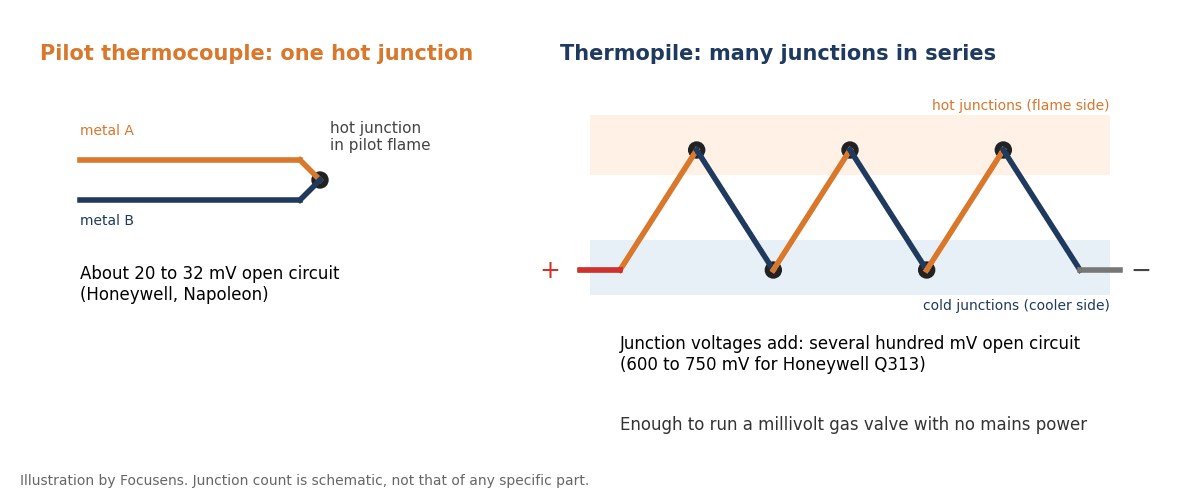
The reason for the difference is the series connection. Britannica defines a thermopile as "a number of thermocouples connected in series" (Britannica), and Honeywell describes its Q313 thermopile as containing "multiple thermocouples connected in series to increase the millivoltage output". Each junction adds its own voltage, so the stack delivers about 23 times the output of a single pilot thermocouple (675 mV against 29 mV, the midpoints of Honeywell's 600 to 750 mV and 26 to 32 mV open-circuit ranges).
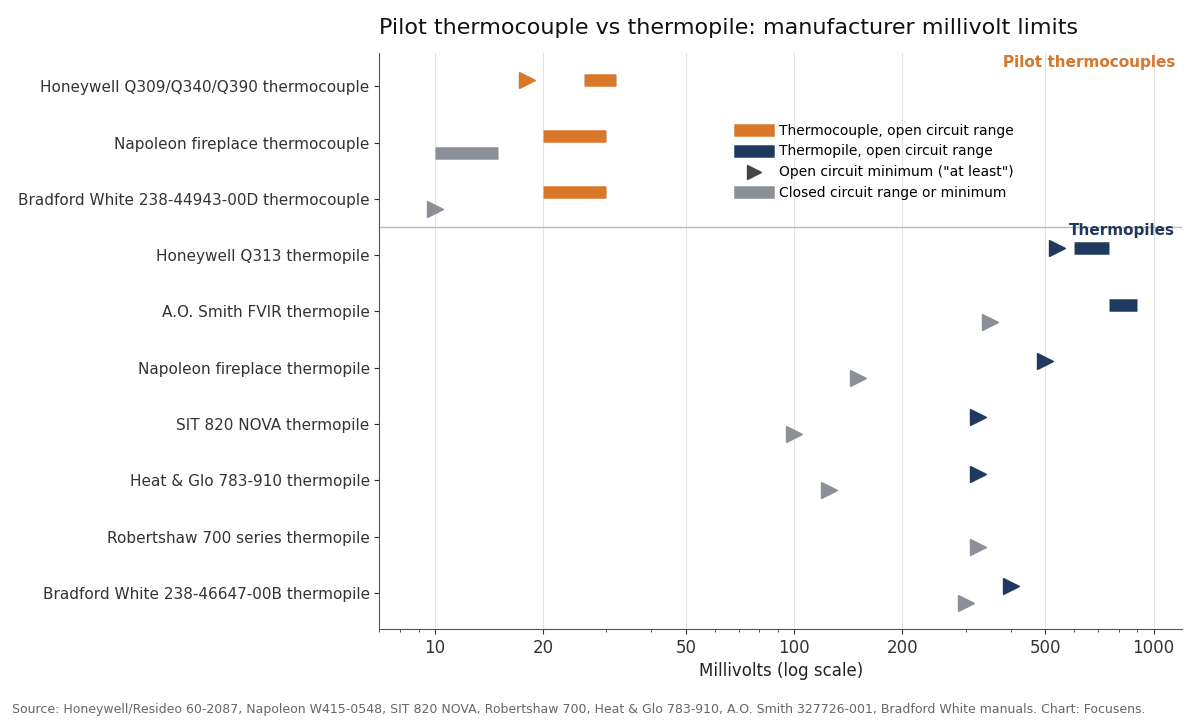
There is no single "good" number. Manufacturers specify open-circuit voltage (leads disconnected from the valve) and closed-circuit voltage (connected and working) separately, and their limits differ.
| Source | Part | Open circuit | Closed circuit / minimum under load |
|---|---|---|---|
| Honeywell/Resideo 60-2087 | Q309/Q340/Q390 thermocouple | 26 to 32 mV normal, 18 mV lowest acceptable | Not given |
| Honeywell/Resideo 60-2087 | Q313 thermopile | 600 to 750 mV normal, 540 mV lowest acceptable | Not given |
| Napoleon service manual, pp. 40 to 42 | Fireplace thermocouple | 20 to 30 mV | 10 to 15 mV |
| Napoleon service manual | Fireplace thermopile | 500 mV or higher | At least 150 mV with the main burner on |
| SIT 820 NOVA mV valve | Thermopile generator | At least 325 mV | At least 100 mV |
| Robertshaw 700 series (all readings closed circuit) | Thermopile | Not given (valve rated for thermopile outputs of 250 to 750 mV) | Thermopile and magnet greater than 325 mV (terminals 1 and 2, thermostat open); valve operator greater than 100 mV (terminals 2 and 3, thermostat closed) |
| Heat & Glo 783-910, pp. 32 to 33 | Fireplace thermopile | 325 mV minimum (leads disconnected; also 325 mV minimum at the valve's TH-TP and TP terminals with the ON/OFF switch off) | Greater than 125 mV (valve knob and ON/OFF switch on) |
| A.O. Smith 327726-001, pp. 7 and 12 | FVIR water heater thermopile (Honeywell control) | 750 to 900 mV | At least 350 mV |
| Bradford White 238-46647-00B, p. 7 | Water heater thermopile (Honeywell control) | Over 400 mV | Over 300 mV |
Honeywell rates the hot junction of the Q309, Q340, Q390 and Q313 at 1400 °F (760 °C) and the cold junction at 780 °F (416 °C). The data sheet does not say at what temperatures its millivolt figures were measured. Closed-circuit limits for pilot thermocouples vary too. Robertshaw's 700-series data replaces a thermocouple below 8 mV in circuit, and Bradford White service manual 238-44943-00D (p. 10) accepts 10 mV or more on White-Rodgers controls and 13 mV or more on Robertshaw. Open-circuit limits differ again: the same Bradford White manual expects 20 to 30 mV (p. 11), and Heat & Glo replaces a thermocouple that reads less than 15 mV disconnected from the valve. For thermopiles, that Bradford White manual gives "Normal thermopile operation will be between 350mV - 850mV" (p. 12). Use the number in your appliance's own manual.
Safety. The manuals cited here restrict this work to trained technicians. Honeywell: "Installer must be a trained, experienced service technician." SIT: "Do not install, replace, or in any way modify the gas valve or the appliance, unless CERTIFIED and QUALIFIED as a Gas Appliance Service Technician on the appliance this valve is used on." After replacing a thermocouple or thermopile, Honeywell requires a gas leak test "every time work is done to the system." If you smell gas, Heat & Glo's lighting instructions say: "Do not try to light any appliance. Do not touch any electric switch; do not use any phone in your building. Immediately call your gas supplier from a neighbor's phone. Follow the gas supplier's instructions." If you cannot reach the gas supplier, call the fire department.
For testing an industrial thermocouple probe on the bench, see how to test a thermocouple with a multimeter.
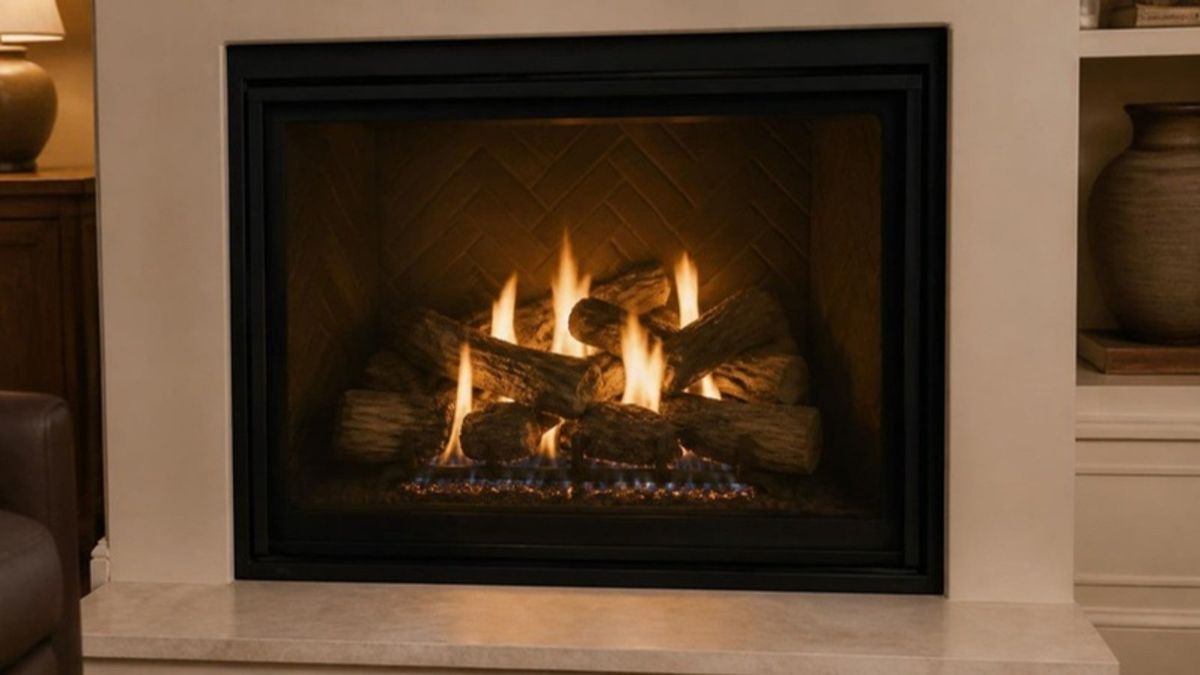
Some gas fireplaces have both a thermocouple and a thermopile. SIT's 820 NOVA valve comes in two versions: the True Millivolt version uses the thermopile generator "to power the main operator and the safety valve", while the Millivolt Plus version uses a thermocouple for the safety magnet and a thermopile for the main operator. Honeywell's data sheet says the same of one of its pilot assemblies: "The Q382 Pilot Burner requires both a Q313 and a Q335", a thermopile and a thermocouple. Heat & Glo's 783-910 manual for its fireplace inserts gives test limits for both parts on the same fireplace. Fireplaces on SIT's True Millivolt version use a thermopile only.
A thermocouple cannot replace a thermopile. No manufacturer cited here says so directly, but the numbers show why: a pilot thermocouple delivers 26 to 32 mV open circuit (Honeywell), while SIT's 820 NOVA millivolt valve needs at least 325 mV open circuit and 100 mV closed circuit, and Robertshaw's 700 series expects more than 325 mV even in circuit. The connections differ too. Honeywell's Q313 thermopile connects to "terminals marked PP on the gas control", while its thermocouples end in a threaded male nut that goes into the female connector of the Pilotstat power unit. The reverse is not a direct swap either, because a thermocouple-only control has no terminals for a thermopile.
Outside gas appliances, the two words describe different measuring tools. A thermocouple measures temperature by contact. A Type K thermocouple produces about 40.5 µV per degree near room temperature, derived from the NIST ITS-90 Type K table (0.798 mV at 20 °C and 1.203 mV at 30 °C, reference junction at 0 °C). It needs cold junction compensation, explained in our guide to cold junction compensation; our page on what affects thermocouple accuracy covers the other error sources. The NIST Type K reference table alone spans −270 °C to 1372 °C; see thermocouple types for the others.
An infrared thermopile measures radiated heat without contact, so it reads a surface it cannot touch, such as a forehead, a moving web or a rotating part. Newport, which uses thermopiles in laser power sensors, says they "connect many thermocouple junctions (typically 20 to 120) in series" (Newport). One example, the Excelitas TPD 1T 0226 detector, has a typical responsivity of 45 V/W (500 K blackbody, 1 Hz, no filter) and a typical time constant of 22 ms. The output is small: NiCeRa puts it at about 12 mV or less for a 100 °C object at 25 °C ambient, depending on the sensor type.
| Thermocouple (contact) | Infrared thermopile (non-contact) | |
|---|---|---|
| What it senses | Temperature of the point it touches | Infrared radiation from a surface in view |
| Signal | Microvolts per degree; needs cold junction compensation | Millivolts from radiated power; needs emissivity and optics |
| Typical use | Furnaces, process piping, ovens, exhaust | Ear and forehead thermometers, pyrometers, gas detectors |
Focusens makes contact thermocouple probes: the FWR series covers Types J, K, T, E, N and S, with grounded or ungrounded junctions, PTFE, silicone, fiberglass, braided or mineral-insulated MgO cable, and a choice of mountings. We do not make gas-valve pilot thermocouples, gas-appliance thermopiles or infrared thermopile detectors, so for a replacement part on a fireplace or water heater, use the part number in the appliance manual.
For industrial temperature measurement, see our thermocouple sensor range and the K-type high-temperature thermocouple. For choosing between sensor technologies, see our comparison of NTC, PTC, RTD and thermocouple sensors and thermocouple vs thermistor.
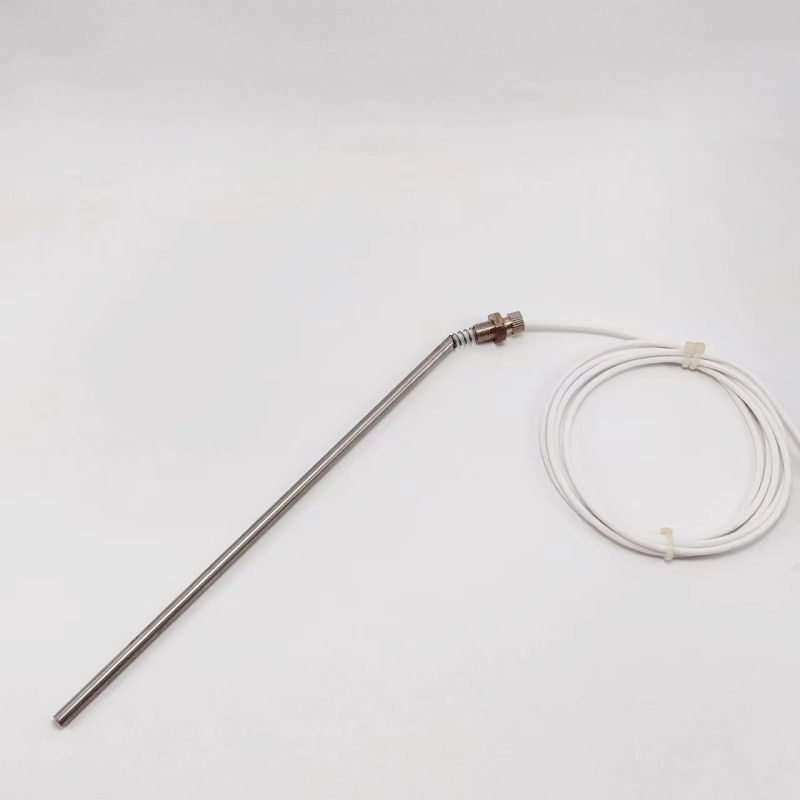
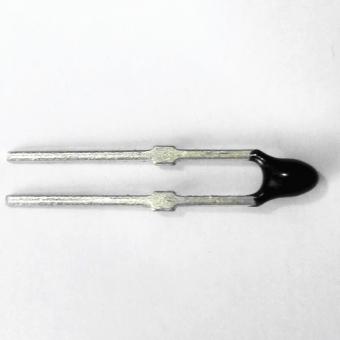
A gas-appliance thermopile is a short metal probe at the pilot with two leads, usually red (+) and white (−), ending in spade or quick-connect terminals. A pilot thermocouple has a single copper-colored lead ending in a threaded nut.
The usual sign of a bad thermopile is a pilot that stays lit while the main burner will not come on. For that case Heat & Glo reads the thermopile terminals with the valve knob and ON/OFF switch on: above 125 mV with no burner flame points at the gas valve; below it, check the switch and wires, then the thermopile. A thermopile is weak or failing when its readings fall below the appliance maker's limits. For example, SIT specifies at least 325 mV open circuit and 100 mV closed circuit, and Heat & Glo 325 mV and 125 mV. Check the pilot flame first: a small or misdirected flame gives low readings from a good thermopile.
Some gas water heaters have thermopiles, including FVIR models with a Honeywell gas control. A.O. Smith's service handbook for residential FVIR gas water heaters (327726-001, pp. 7 and 12) gives 750 to 900 mV open circuit and at least 350 mV closed circuit, with the thermopile connected to the Honeywell control. Bradford White's 238-46647-00B (p. 7) expects over 400 mV open circuit and over 300 mV closed circuit. Many standing-pilot water heaters use a single thermocouple.
Neither is better in general; each does a different job. In a gas appliance a thermopile produces enough voltage to run a valve, where a thermocouple only holds one open. In measurement, a contact thermocouple is the better choice for high temperatures and harsh process conditions, and an infrared thermopile for surfaces you cannot touch.
The difference between a thermocouple and a thermopile is the number of junctions. A thermocouple has one hot junction; a thermopile has many in series, so its voltage is many times higher.
Reviewed by the Focusens Engineering Team on October 1, 2026. Millivolt limits come from the Honeywell/Resideo 60-2087, Napoleon (Wolf Steel) W415-0548, SIT, Robertshaw, Heat & Glo, Bradford White and A.O. Smith documents linked beside each value; some are copies hosted by third parties. Sensor physics comes from Britannica, Newport, Excelitas, NiCeRa and the NIST ITS-90 tables. The junction diagram is an illustration and the fireplace image is AI-generated. Focusens does not make gas-appliance thermocouples or thermopiles, and no reading on this page is a measurement taken by Focusens.
No.1 XiSan Road, Electromechanical Industry Park , High&New Tech.Zone. Hefei,Anhui,China
โทร : +86-551-69109668
Whatsapp : +86-13339100504
อีเมล : info@focusens.com
Skype : melodyliu520






 +86-551-69109668